Expertise · AI visibility
My AI visibility method: from entity recognition to AI recommendation
Maryanna Franco, founder of BrilliantSEO, uses one repeatable method to make people and companies recognised, trusted and recommended by AI assistants, including ChatGPT, Gemini, Perplexity and Google AI Overviews.
- 1Establish a unique identityMy own name change
- 2Disambiguate from namesakesKoert Bloemers
- 3Build authority through corroborationKase Filters Europe
- 4Get recognised as a distinct entityVan Express
- 5Get recommended by AIVan Express · Recognition–Recommendation Gap research
The method has been applied to four kinds of entity: a personal name, a company founder competing with a namesake, a product brand and a B2B logistics company. Original research across 14,140 prompt runs explains why AI recommends some brands over others. Each stage of the method is documented in a separate, published case study, and this page explains how those cases connect.
Why AI recommendation is the last step, not the first
An AI assistant cannot recommend a company it cannot identify, and it will not confidently recommend a company whose claims it cannot corroborate from independent sources.
Most advice on Generative Engine Optimisation (GEO) starts at the recommendation itself, with content written to match the questions people ask AI. In my experience, and in the research described below, recommendation depends on a chain of earlier conditions. The AI has to know who the entity is, tell it apart from similar entities, connect it to the right category, and find independent sources that confirm it belongs there.
My method works through that chain in order:
- Establish a unique, consistent identity.
- Disambiguate the entity from others with the same or a similar name.
- Build authority through independent, third-party corroboration.
- Get recognised by search engines and AI systems as a distinct entity with a clear category.
- Get recommended when someone asks AI for a provider in that category.
The sections below show where each stage has been applied, what the result was, and what each case does and does not prove.
Stage 1
Establishing a unique identity (my own name)
On 22 April 2025 I changed my professional name from Mariana Franco to Maryanna Franco. Mariana Franco is a common name, with more than 200 people and identity entries associated with it in Google’s Knowledge Graph, so search engines and AI assistants could not reliably identify me as one specific professional.
Within seven days of the change, every result on Google’s first page for my new name was about me. Within ten days, ChatGPT, Perplexity and Gemini were returning consistent information about who I am. Google assigned a Knowledge Graph identifier in November 2025, and a Knowledge Panel followed in May 2026.
I carried out this project with Kalicube and Jason Barnard, using Kalicube’s methodology of building an Entity Home, aligning profiles and references across the web, and implementing structured data.
The identity stage can be completed quickly when a unique name is paired with consistent, corroborated information.
That I can do this independently, which is why the next case matters.
Stage 2
Disambiguating a person from a namesake (Koert Bloemers)
Koert Bloemers is the Founder and CEO of Van Express and Blloog. When I started working on his personal brand, Google and AI assistants confused him with a marketing executive at a multinational health technology company who shares his name. That namesake often ranked first in Google, the search results mixed the two men, and AI assistants could not tell them apart.
This is a harder version of the identity problem than my own, because another real person already held the results for the name.
I first rebuilt Koert’s About page, which gained him most of the first page of results while the namesake still held position one. I then established independent corroboration: a podcast appearance, articles in logistics trade publications including Logistics Business and SupplyChainBrain, and his book, The 2026 EU Logistics Transformation Playbook. About seven months after that second phase, Google gave Koert a Knowledge Panel, and AI assistants now identify him as the primary Koert Bloemers. The project had no budget.
This project was carried out without Kalicube’s involvement. Koert Bloemers and Kalicube are separate clients, and no Kalicube tools or methodology were used for his work. I also work with Van Express, the company Koert founded, as its Head of Marketing since October 2025.
I can apply the identity and disambiguation stages to another person on my own, including against an established namesake.
That a Knowledge Panel will always appear, or that every ambiguity has disappeared. Google’s internal decision process is not visible.
Stage 3
Building brand authority and search visibility (Kase Filters Europe)
Kase Filters Europe is a camera filter brand. For Kase, I combined technical SEO, content structure, topical authority, semantic SEO and internal linking, entity optimisation and third-party expert references.
Kase Filters Europe achieved 47% presence in Google AI Overviews across the monitored US search terms, even though it does not directly target the US market. It also appears in a Google Knowledge Panel in the US, ranked second in US non-branded share of voice behind YouTube, and was the leading domain in the monitored US People Also Ask analysis.
Christian Armbrüster, CEO of Kase Filters, said: “Maryanna and her team understand the market needs even in different languages. Their technical attention and strategic minds have been completely essential for our growth.” Read more on the testimonials page.
The method works for a product brand as well as for people, and brand authority built through search carries over into Google’s AI-generated results.
ChatGPT or Gemini recommendations. This case measures Google AI Overviews only.
Stages 4 and 5
From recognition to recommendation and revenue (Van Express)
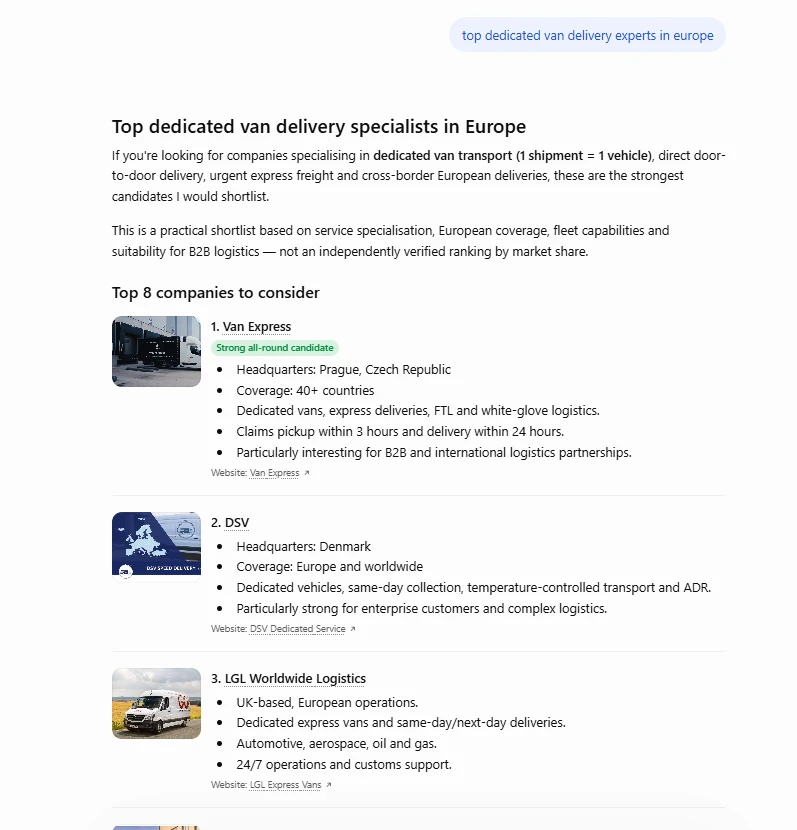
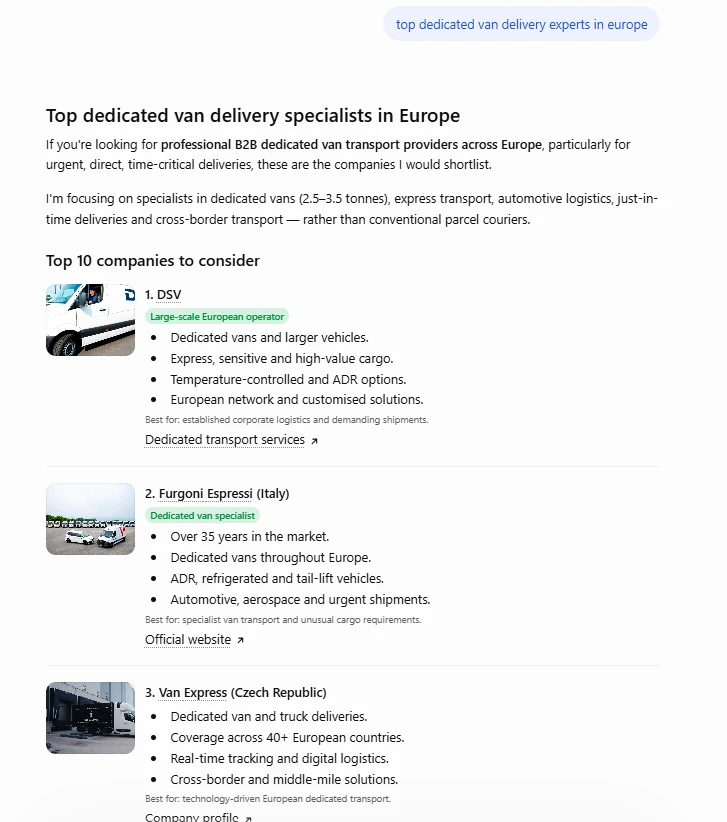
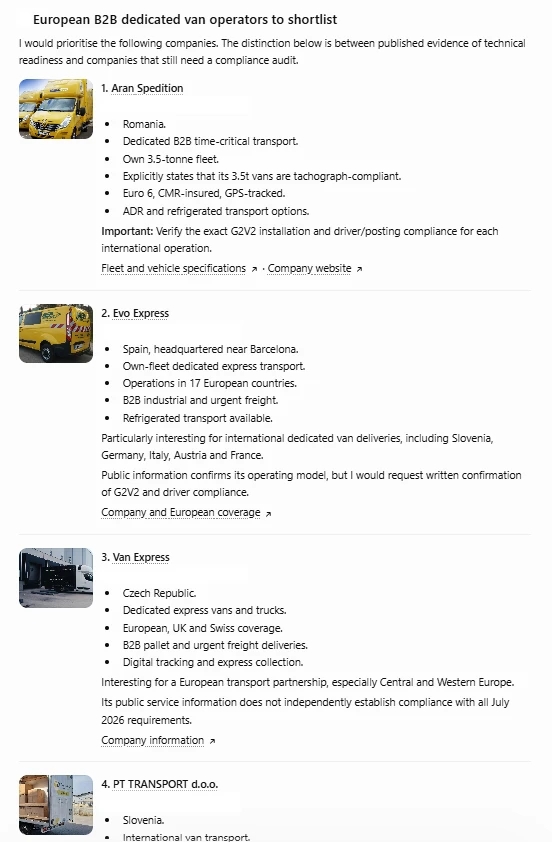
Van Express is a cross-border express logistics company headquartered in Prague. ChatGPT ranked Van Express first of eight providers for the prompt “top dedicated van delivery experts in Europe”, and third for a specific B2B query about compliance with the 2026 EU van regulations. AI answers vary between runs: in another run of the same prompt, Van Express was third of ten. Between June and October 2026, weekly AI citations of Van Express grew from about 700 to 4,850.
I tracked AI Assistant sessions and leads as GA4 key events over the same weeks. When the logistics glossary went live, citations jumped to 4,850 in a week, but AI Assistant sessions stayed between 15 and 40 a week (34 in the glossary week) and leads between 0 and 12 a week (12 in the glossary week).
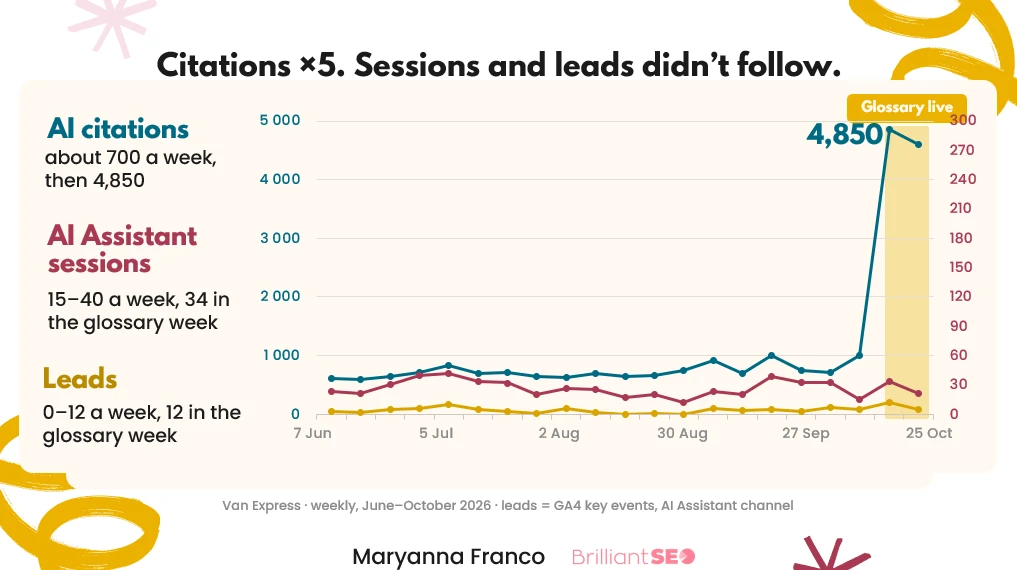
Citations, sessions and leads did not always rise together, and I report where they did not. Citations multiplied by five; sessions and leads did not follow at the same rate.
Because my role at Van Express makes me accountable for leads and revenue, not only for visibility, this case is a stricter test than a visibility report.
The earlier stages can lead to actual AI recommendations and to commercial results.
How an arm’s-length client would perform. This is an in-house case.
The research behind the recommendation stage: the Recognition–Recommendation Gap
Recognition and recommendation are different outcomes, and a brand can have the first without the second. Together with João da Silva of FrictionAI, I ran 14,140 prompts across ChatGPT, Gemini, Claude, Perplexity and Google AI Overviews, testing twelve athletic apparel brands in May 2026.
New Balance was recognised in 100% of tests but recommended for athleisure in only 3.4% of responses, while lululemon was recommended in 92.5%. The research shows that AI recommends brands according to the category they are associated with and the brands they appear alongside in independent sources, not according to how well the AI knows the brand.
This research explains why my method does not stop at recognition. Category association and independent co-mentions are what turn a known entity into a recommended one.
Full case studyThe Recognition–Recommendation Gap →Paper: doi.org/10.5281/zenodo.20331344. I also wrote about how entity confusion affects AI visibility for Search Engine Land.
How I measure AI visibility
I measure AI visibility with my own automated setup: a scheduled script that sends a fixed set of prompts to four or five AI systems, including ChatGPT, Gemini, Perplexity and Google AI Overviews, three times a day for one week. Each prompt is run from the market where the brand wants to sell, so results reflect the answers its real customers see.
The prompts follow the same chain as the method, from identity to recommendation, with three or four wordings of each:
“What is [brand]?” · “What does [brand] do?” · “What does [brand] provide or offer?”
“What is the best brand for [purpose]?” · “…for [purpose] in [industry]?” · “…for [audience]?”
After each week-long run I stop and review before running again. I look for where the brand drops out: keeping the same need and adding one condition at a time shows exactly which wording or use case loses it, while unrelated questions only show that it was lost. I then compare which sources are cited and which brands appear alongside it with the category leader, adjust, and run again. Once the picture is stable, I re-run monthly, or after each significant change.
I report three outcomes separately: whether a brand is mentioned, whether it is cited as a source, and whether it is recommended. Only recommendation brings customers, and visibility scores that combine all three can hide that difference: two brands can both score 80% while one is mostly cited as a source and the other is mostly recommended. Where possible, I connect AI visibility to sessions and leads in GA4, as in the Van Express case above.
I presented this diagnostic approach in my talk at Digital Marketing Europe Vilnius 2026, and explained why citations are not recommendations in my interview with Majestic.
What a Knowledge Panel does and does not show
Three of the entities in my case studies have Google Knowledge Panels: me, Koert Bloemers and Kase Filters Europe in the US. Google generates Knowledge Panels automatically when it has enough consistent, corroborated information to understand an entity, and they cannot be requested or purchased.
A Knowledge Panel is therefore visible evidence that the identity, disambiguation and authority stages have worked. It is not a cause of AI recommendations, and it does not guarantee them. Recommendation also needs the AI to associate the entity with the right category and to find it alongside the right competitors in independent sources.
In my method, the Knowledge Panel is a milestone, not the goal.
The disciplines the method combines
| Discipline | What it does | Where I applied it |
|---|---|---|
| Technical SEO | Makes information accessible to search engines and AI | Kase Filters Europe |
| Entity SEO | Establishes who or what the entity is | My name change, Koert Bloemers |
| Semantic SEO | Establishes relationships and context | Kase Filters Europe |
| Digital PR | Builds independent corroboration | Koert Bloemers, Van Express |
| Knowledge Graph optimisation | Improves entity recognition | Three Knowledge Panels |
| Generative Engine Optimisation | Improves visibility in AI-generated answers | Van Express, Kase Filters Europe |
| Conversion measurement | Connects AI visibility to leads and revenue | Van Express |
What I learned from Kalicube, and what I do on my own
I learned the entity method through my own name change, which I carried out with Kalicube and Jason Barnard. The terms Entity Home and Claim, Frame, Prove were coined by Jason Barnard. My work for Koert Bloemers, Kase Filters Europe and Van Express was done without Kalicube’s involvement.
Frequently asked questions
Can Maryanna Franco get results without Kalicube?
Yes. The Koert Bloemers, Kase Filters Europe and Van Express projects were carried out without Kalicube’s involvement. Only her own name change was done with Kalicube.
Is Van Express an independent client?
No. Maryanna Franco has been Head of Marketing at Van Express since October 2025, so Van Express is an in-house case, in which she was accountable for leads and revenue as well as visibility.
Does the method work across ChatGPT, Gemini, Perplexity and Google AI Overviews?
Her published cases include results in ChatGPT (Van Express) and Google AI Overviews (Kase Filters Europe), and her research covered five AI systems. No one can guarantee that an AI assistant will recommend a particular company.
What is the difference between being recognised and being recommended by AI?
Recognition means the AI knows who a brand is. Recommendation means it suggests the brand when asked for providers in a category. Her research found brands recognised in 100% of tests but recommended in under 4% of responses.
More answers on the FAQ page.
Key facts
- Maryanna Franco is the founder of BrilliantSEO.
- Her AI visibility method has five stages: establish, disambiguate, build authority, get recognised, get recommended.
- She has applied it to her own name, to Koert Bloemers, to Kase Filters Europe and to Van Express.
- The Koert Bloemers project was carried out without Kalicube’s involvement.
- Kase Filters Europe achieved 47% presence in Google AI Overviews across the monitored US search terms.
- ChatGPT ranked Van Express first of eight European dedicated van delivery providers.
- She co-authored the Recognition–Recommendation Gap study with João da Silva of FrictionAI, covering 14,140 prompt runs.
Connected work
The evidence behind the method
From Mariana Franco to Maryanna Franco
Seven days to a clear Google presence, ten days to AI recognition.
Koert Bloemers
From name ambiguity to a Google Knowledge Panel, with no budget.
Kase Filters Europe
47% presence in US Google AI Overviews without a US campaign.
Van Express
From AI recognition to AI recommendation, measured against leads.
The Recognition–Recommendation Gap
14,140 prompt runs across five AI systems, with FrictionAI.
AI citations aren’t recommendations
How to measure what AI visibility actually means.
Want this method applied to your brand or taught to your team? See speaking, corporate training or more about Maryanna.
Let’s talk
Make your brand the one Google and AI recommend.
Book a free 30-minute call with Maryanna to talk through your SEO, GEO and AI visibility, and leave with clear next steps for your brand.
- Free 30-minute call
- SEO, GEO & AI visibility
- English or Portuguese