
Case study · B2B marketing leadership
Van Express Case Study: Building an Integrated Marketing Strategy That Drives Commercial Growth
Scope: Marketing strategy, SEO, content, social media, PR, email marketing, brand development, analytics and sales alignment
The results at a glance
Commercial growth 2025 vs January–November 2026
Marketing reach across channels
These results reflect a wider transformation of Van Express’s marketing activities, with organic visibility, brand development, content distribution and commercial growth becoming part of a coordinated strategy.
The challenge: Connecting marketing with business growth
When I joined Van Express as Head of Marketing in October 2025, the opportunity was to develop a more structured, integrated approach to marketing.
Van Express operates in a competitive European logistics market, providing dedicated transport, express van deliveries and cross-border logistics services.
Reaching potential customers requires visibility across several stages of the buying journey. Some businesses actively search for a transport provider. Others discover suppliers through professional networks, industry publications, recommendations or existing relationships.
The challenge was to develop marketing that could reach these audiences, communicate the company’s expertise and support commercial growth.
This required coordinating activities that had previously been less developed or less connected, establishing clearer priorities and creating a stronger relationship between marketing and sales.
The objective was to build a marketing operation capable of generating demand, strengthening brand recognition and supporting the acquisition of new customers.
The strategy: Building a connected marketing operation
I introduced, restructured and expanded marketing activities across seven areas:
- Marketing strategyEstablishing priorities, coordinating channels and connecting marketing activities with commercial objectives.
- SEO and contentExpanding organic search visibility through technical improvements, service content, educational resources and a broader website content strategy.
- Social mediaDeveloping coordinated organic content across LinkedIn, Facebook, Instagram and YouTube.
- PR and thought leadershipBuilding visibility through industry publications, podcasts, articles and expert-led content.
- Email marketingDeveloping communication with prospects and existing customers to support engagement and commercial relationships.
- Tracking and measurementImproving visibility into marketing performance, identifying tracking gaps and working towards more reliable attribution.
- Sales alignmentConnecting marketing priorities with customer needs, sales communication and business development.
The strategy was based on a simple principle: marketing channels should reinforce one another.
An industry article could support search visibility, provide material for LinkedIn, strengthen the founder’s credibility and become a resource for email communication or sales conversations.
Instead of producing isolated campaigns, we worked towards a connected system in which individual activities contributed to several marketing objectives.
Building and leading the marketing team
As Head of Marketing, my responsibility extended beyond strategy development to coordinating the people and resources needed to execute it.
The marketing team included:
- A social media specialist who also supported PR activities.
- A content writer responsible for developing written content.
- A photographer and videographer supporting visual content production.
I coordinated the team’s activities, established priorities and connected their work with the wider marketing strategy.
We also collaborated with a PPC specialist when paid campaigns were required. However, paid advertising results are excluded from the organic performance analysis presented in this case study.
This structure allowed us to expand marketing across multiple channels while maintaining a consistent brand direction.
SEO: Expanding search visibility and building a stronger content foundation
Organic search was one of the major areas of development.
The SEO strategy focused on improving the website’s ability to reach potential customers searching for European transport and logistics solutions.
Our work included expanding service-related content, developing dedicated pages for relevant transport searches, strengthening internal linking and improving the website’s technical foundations.
We also expanded educational content to address logistics questions, industry developments and topics relevant to potential customers.
The objective was to improve visibility across the customer journey, from informational research to searches indicating a need for a transport provider.
Organic search results
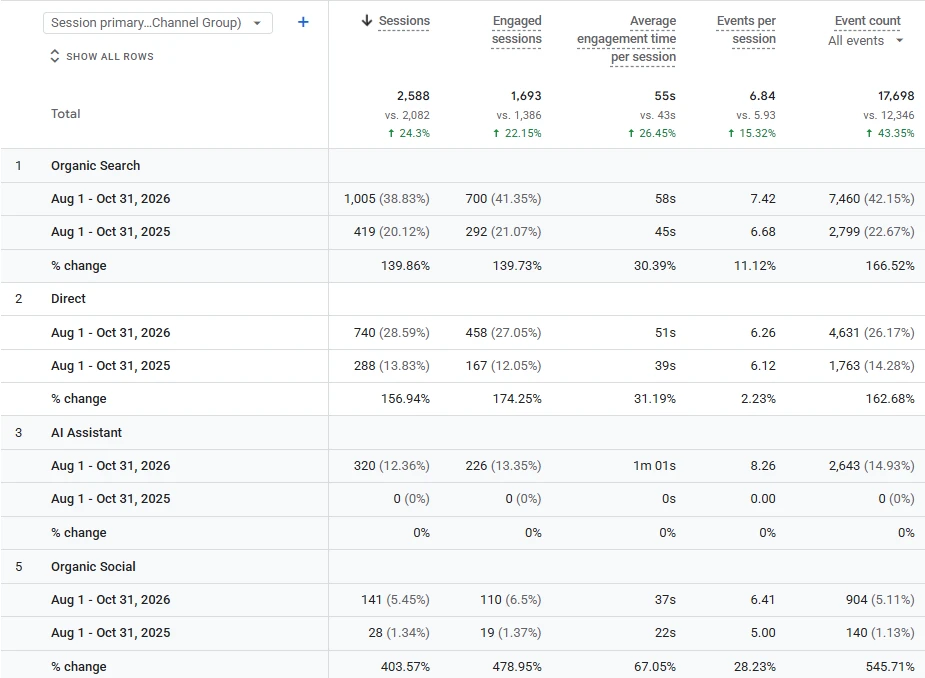
Comparing August–October 2026 with the same period in 2025:
| Metric | Growth |
|---|---|
| Organic search sessions | +139.86% |
| Engaged organic sessions | +139.73% |
| Average engagement time per session | +30.39% |
| Organic search event count | +166.52% |
Google Search Console data for the same three-month comparison showed:
| Metric | Change |
|---|---|
| Organic search clicks | +235% |
| Search impressions | +304% |
| Average position | Improved from 36.6 to 23.5 |
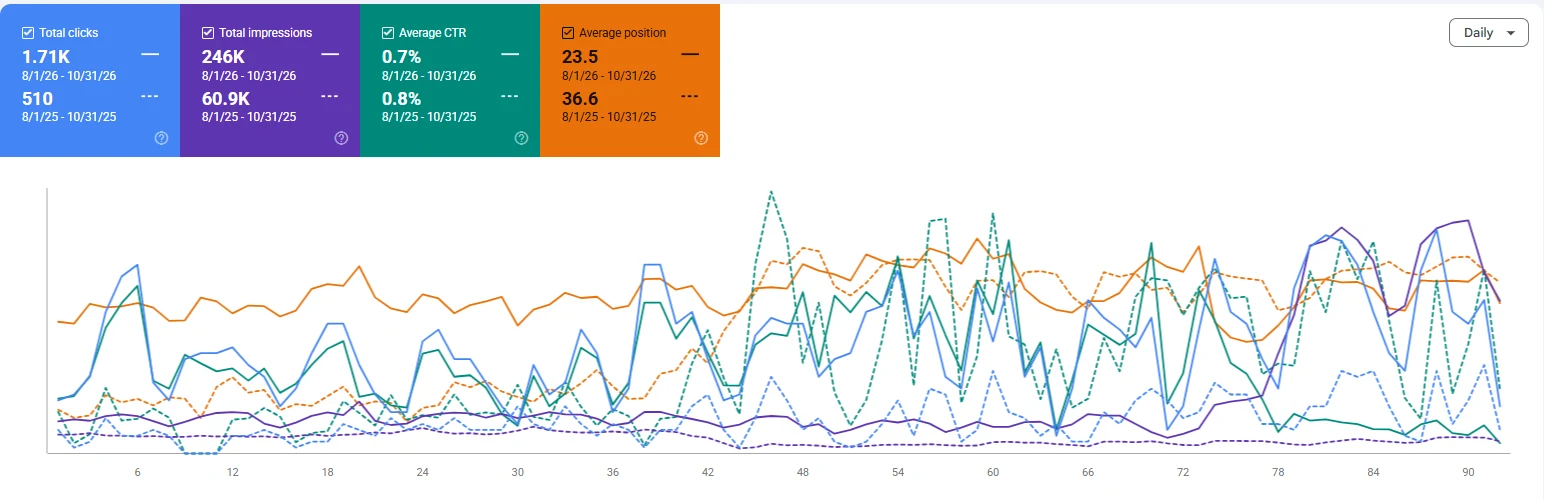
These results demonstrate substantial growth in organic search visibility and website visits.
The improvements were achieved while the company continued expanding its content and service-page coverage.
Expanding visibility in AI search
Alongside traditional SEO, we monitored the website’s visibility in AI-powered search experiences and traffic originating from AI assistants.
The content strategy expanded the range of topics and questions for which Van Express could appear as a source.
Google Search Console reported approximately 44,000 impressions in its Generative AI features report, with a particularly strong increase during October and November 2026.
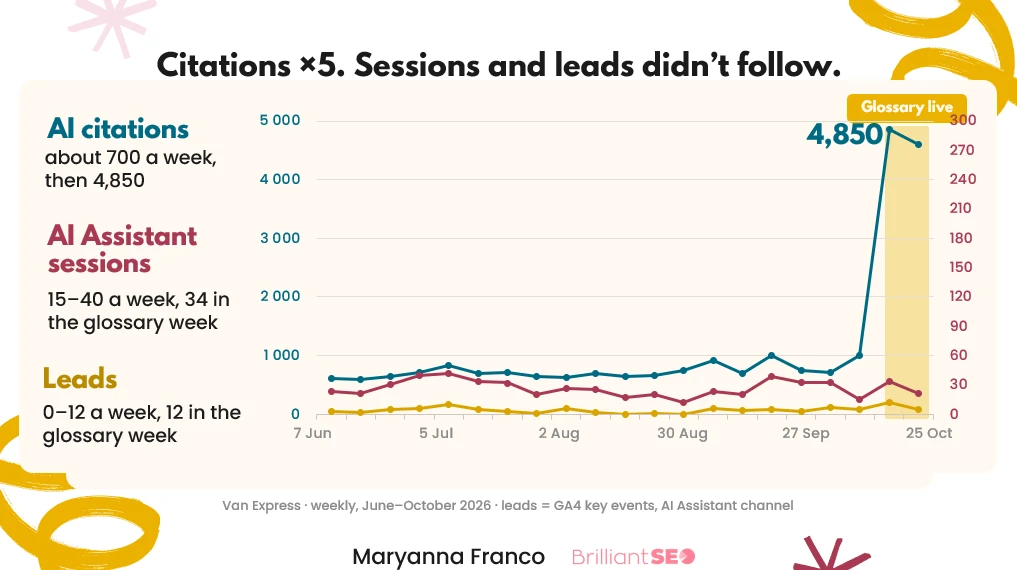
We also tracked AI citations weekly, alongside AI Assistant sessions and leads recorded as GA4 key events. Between June and October 2026, weekly AI citations grew from about 700 to 4,850 when the logistics glossary went live. AI Assistant sessions stayed between 15 and 40 a week, and leads between 0 and 12 a week.
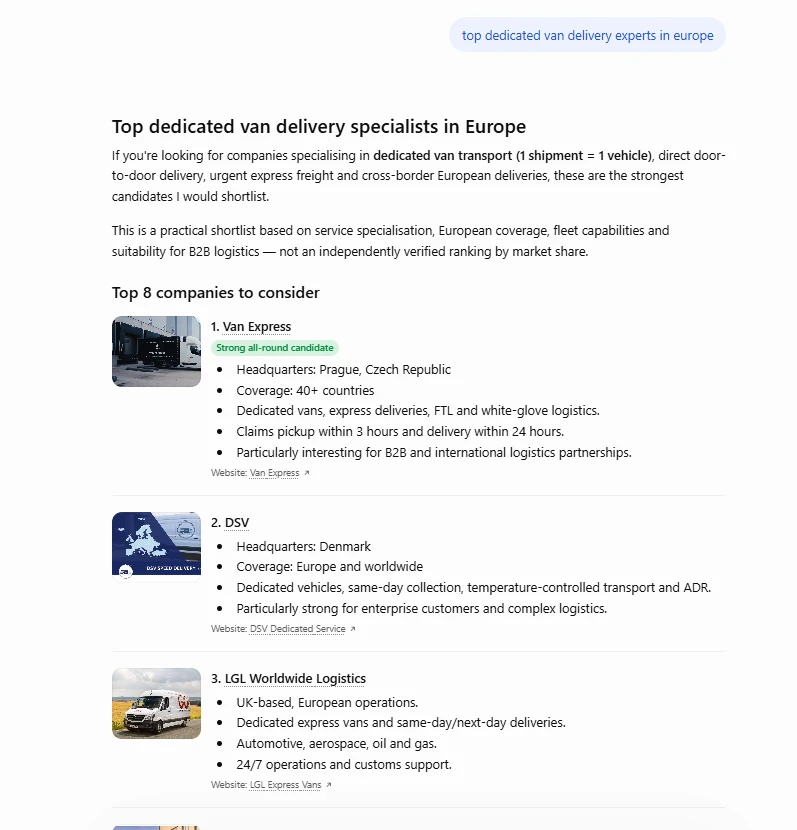
ChatGPT also ranked Van Express first of eight providers for the prompt “top dedicated van delivery experts in Europe”, and third in a shortlist for a B2B query about compliance with the 2026 EU van regulations. AI answers vary between runs: in another run of the same prompt, Van Express was third of ten.
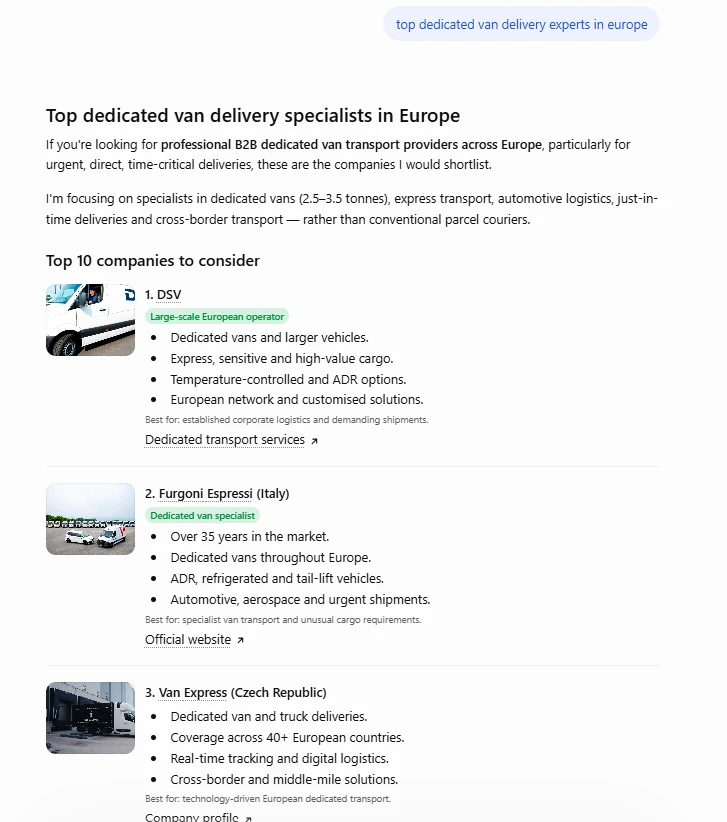
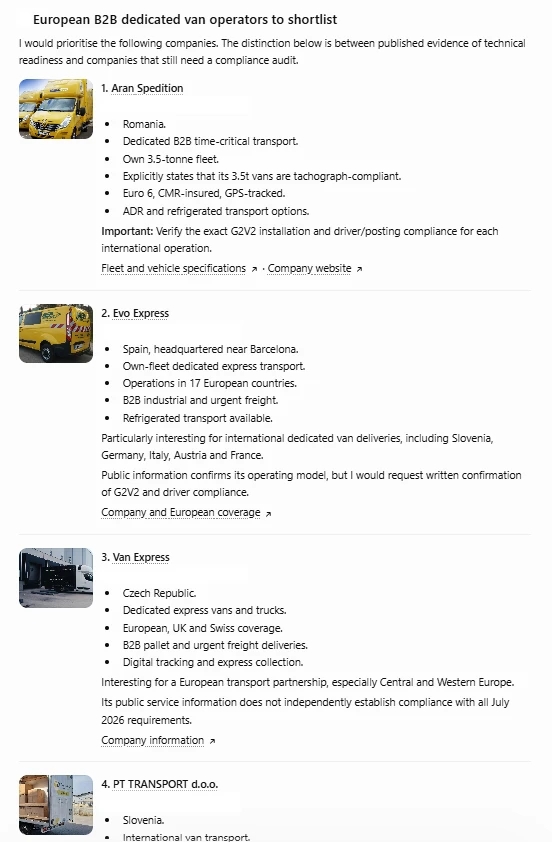
This was an important development in the company’s search visibility, although AI citations, brand recommendations and commercial enquiries remain distinct outcomes.
Our approach therefore focused on evaluating different types of visibility rather than assuming that additional AI citations automatically translated into new customers.
Social media: Developing a multi-channel organic presence
Social media became an important component of the wider marketing strategy.
We developed content across LinkedIn, Facebook, Instagram and YouTube, with LinkedIn serving as the primary B2B channel.
The objective was to strengthen brand recognition, communicate the company’s expertise and reach audiences beyond those actively searching for transport services.
Content included industry insights, educational material, company developments, logistics expertise, photography and video.
LinkedIn: Strengthening B2B visibility
LinkedIn played a central role in reaching professionals working in logistics, supply chain management and related industries.
The Van Express company page generated approximately 29,000 organic content impressions over the reporting period from November 2025 to November 2026.
During the same period, the company page gained 528 followers.
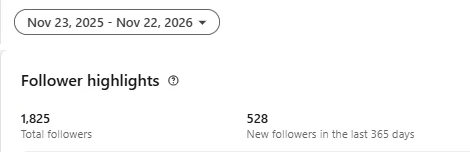
We used LinkedIn to distribute content, communicate the company’s expertise and strengthen its professional presence.
Organic social traffic
The impact of expanding social media activities was also visible in website traffic.
Comparing August–October 2026 with August–October 2025, organic social sessions increased by 403.57%.
Engaged sessions from organic social increased by approximately 479% over the same period.
These figures demonstrate that the growth in social media activity was accompanied by a substantial increase in website visits originating from unpaid social channels.
YouTube: Expanding video content
Video became another part of the content strategy, supported by dedicated photography and video production.
YouTube provided an additional channel for communicating Van Express’s services, sharing industry knowledge and distributing educational content.
Comparing 2026 year-to-date through November 23 with the full year 2025:
- YouTube views increased by approximately 490%.
- Watch time increased by approximately 262%.
Although YouTube remained a developing channel, the results demonstrated growing consumption of the company’s video content.
Facebook and Instagram
Facebook and Instagram complemented the company’s wider content distribution activities.
Facebook recorded 600 new follows during 2026, reflecting an expansion of the company’s audience.
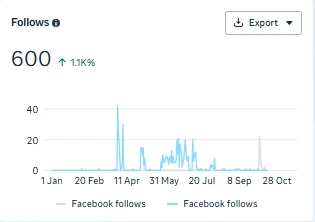
Because Van Express also ran paid recruitment campaigns on Meta, reach, impressions, interactions and link clicks from these platforms have been excluded from the organic performance analysis.
PR, industry content and thought leadership
PR and thought leadership were developed as part of the wider marketing strategy.
The objective was to increase Van Express’s visibility beyond its owned channels and strengthen the company’s association with expertise in European logistics.
Activities included industry articles, podcast appearances, educational resources and content addressing developments affecting European transport businesses.
These activities supported several objectives simultaneously: reaching relevant audiences, strengthening credibility, creating material for social media and email communication, and providing additional context for the company’s expertise.
One example was the development and promotion of The 2026 EU Logistics Transformation Playbook, addressing regulatory and technological changes affecting European van transport.
By connecting industry knowledge with content distribution, we worked to establish a stronger relationship between the company’s expertise and its market positioning.
Developing the founder’s personal brand
An important part of the strategy involved strengthening the professional visibility of Koert Bloemers, founder and CEO of Van Express.
With more than 25 years of experience in international logistics, Koert brought substantial industry knowledge that could support the company’s credibility and market positioning.
We developed his professional visibility through LinkedIn content, industry insights, publishing and a stronger digital presence.
The objective was to establish a clearer association between Koert, his expertise and the logistics topics relevant to Van Express’s customers.
Personal brand results
Over the reporting period:
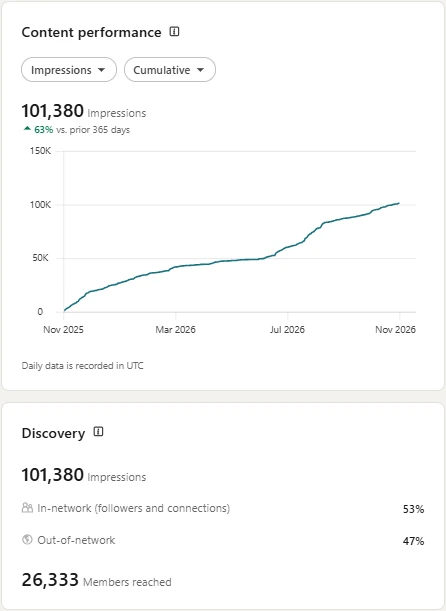
His audience also included substantial representation from professionals in transportation, logistics, supply chain management and storage.
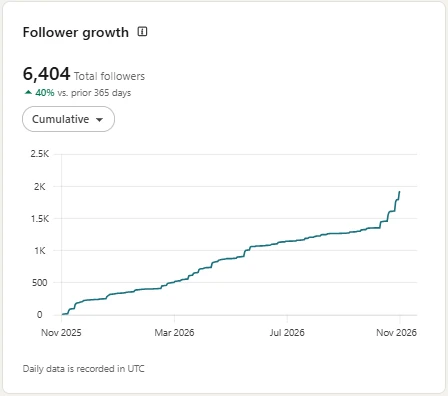
Beyond LinkedIn, we worked on strengthening the connections between his professional biography, publications, company affiliations and online profiles.
Google search results displayed an information panel associating Koert with his logistics publication, alongside results from Van Express and other professional platforms.
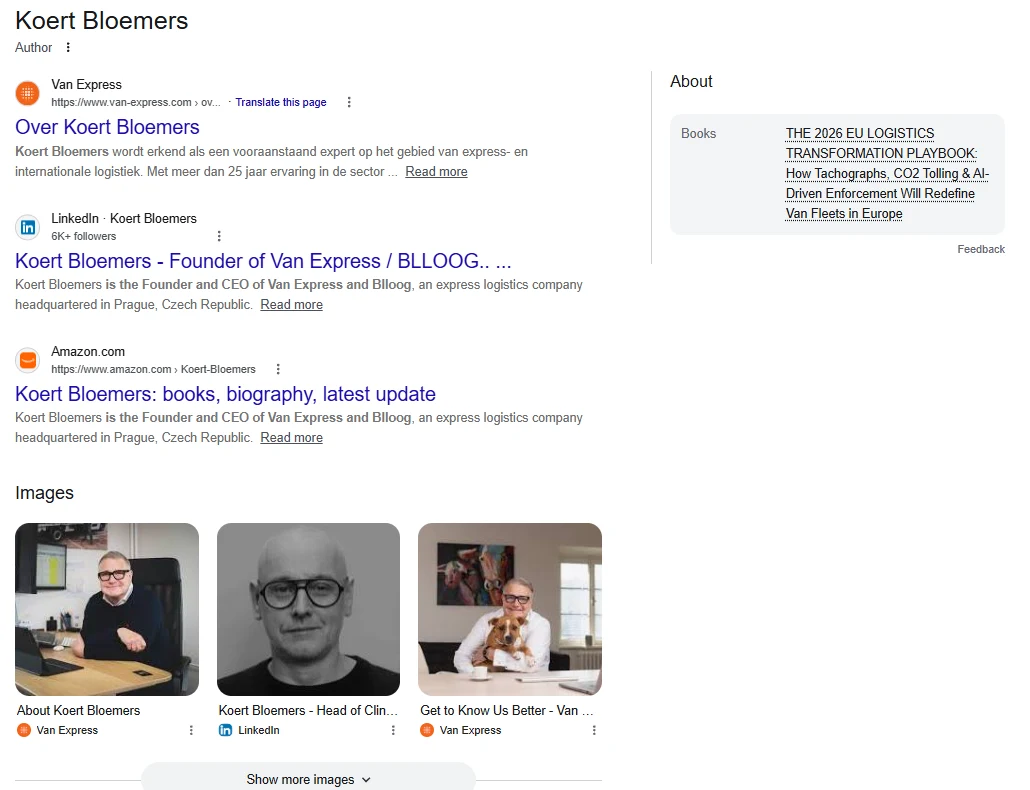
This supported the wider objective of developing visibility for both the company and the people behind it.
Read how this work turned a shared name into a Google Knowledge Panel in the Koert Bloemers case study.
Email marketing and sales alignment
Email marketing formed part of the effort to connect brand development and content with commercial activity.
We developed communication that could support customer relationships, distribute relevant content and maintain contact with prospects and existing customers.
Marketing also worked alongside sales to improve the relevance and consistency of commercial communication.
This included aligning messaging with the company’s services, developing supporting content and ensuring that marketing activities reflected the needs of potential customers.
The objective was to create continuity between discovering Van Express, understanding its capabilities and entering a commercial conversation.
Measurement: Building a more reliable picture of marketing performance
Improving marketing measurement was another priority.
While Google Analytics 4 and Google Search Console provided useful data about website traffic, visibility and engagement, conversion tracking was not sufficiently reliable to measure all commercial outcomes accurately.
We identified gaps in the tracking setup and worked towards better integration between website activity and commercial data.
This distinction was important.
Growth in traffic, impressions or engagement could demonstrate increased visibility and audience interest, but these metrics could not independently establish how many new customers or orders marketing generated.
For this reason, the commercial evaluation of the strategy relied on operational and sales data rather than attributing conversions to individual channels through incomplete GA4 tracking.
Commercial impact
Commercial impact: Connecting marketing with spot-order growth
The central commercial objective of the marketing transformation was to support business growth.
An important indicator was the development of spot orders: transport orders placed in response to immediate or individual shipping requirements rather than recurring contracted transport.
Spot orders provided a useful commercial measure because they reflected actual customer demand and business activity.
The growth in spot orders took place alongside the expansion of marketing activities, including SEO, content, social media, PR, email marketing and closer alignment with sales.
These activities worked together to increase the company’s visibility, communicate its capabilities and support customer acquisition.
The spot-order analysis provides the commercial evidence for the wider case study. An internal FireTMS analysis comparing 2025 with January–November 2026 showed:
| Business indicator | Change |
|---|---|
| Average monthly revenue from spot-type clients | +197% |
| Average monthly spot-type orders | +156% (3.4 to 8.7 per month) |
| Active spot-type clients | +110% (29 to 61) |
| Average spot-type order value | +17.5% |
| Spot-type share of total revenue | 1.3% to 3.2% |
| Spot-type order value vs other orders (2026) | Approximately 57% higher |
The commercial results should be interpreted as the outcome of a broader business effort, with marketing contributing alongside sales, customer relationships and operational performance.
The outcome: A more connected marketing operation
Over the first year, Van Express developed a broader and more coordinated marketing presence.
Organic search visibility increased substantially. The company expanded its content and service-page coverage, strengthened its social media presence, developed video content and increased its investment in thought leadership.
The founder’s personal brand became a more visible part of the company’s communication strategy.
At the same time, marketing activities became more closely connected with sales and commercial priorities.
The result was a marketing operation with a clearer strategy, dedicated execution resources, stronger organic visibility and a growing foundation for long-term brand development.
Key takeaway
Key takeaway
Marketing performance cannot be understood through a single channel.
Search visibility helps potential customers discover a business. Social media and PR expand its reach. Educational content communicates expertise. Personal branding strengthens credibility. Email marketing and sales activity help maintain relationships and turn interest into commercial opportunities.
At Van Express, the focus was on developing these activities as parts of one connected strategy.
The growth in organic visibility, audience engagement and commercial activity illustrates the value of coordinating marketing around the customer journey and the company’s business objectives.
The goal was never simply to generate more traffic. It was to build marketing that could contribute to business growth.

About the author
Maryanna Franco is an SEO and GEO consultant, founder of BrilliantSEO, and international conference speaker specialising in technical SEO, AI visibility, entity optimisation and conversion-oriented search strategies.
Let’s talk
Make your brand the one Google and AI recommend.
Book a free 30-minute call with Maryanna to talk through your SEO, GEO and AI visibility, and leave with clear next steps for your brand.
- Free 30-minute call
- SEO, GEO & AI visibility
- English or Portuguese